MANAGE YOUR FOREX ACCOUNT
Forex2Earn has specialized team in providing professional Forex investment management account on a discretionary basis wide variety of markets including the worldwide inter-bank foreign exchange (Forex) market. Its programs are technical, trend-following, support & resistance, volatility systems and are speculative in nature. In managed account you don't need to send money to us its very simple you just have to open an account with your bank nearest to your locality . We will only open your account with FXCM on your request with your name. Managed account investors are advised to carefully check your account statement weekly, fortnightly and monthly basis. Invest in your future and Trade FOREX with a managed account. Forex2Earn team is always ready and vigilant to manage you accounts.Friday, July 31, 2009

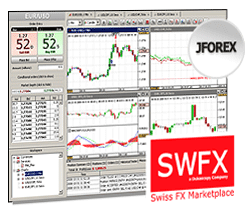
JFOREX platform is recommended for traders or developers experienced in programming and interested in automated trading or developing and testing their own trading strategies based on JAVA language. The main functionality and interface of the platform are similar to those of Java platform. In addition, a built-in cross-platform interface for execution of custom strategies or programming code is provided. Integrated technical analysis tool allows to follow the positions directly from the charts.
 Main features:
- Optimized for auto and chart trading
- API for strategies and indicators
- Historical tester and built-in charts
Requirements:
Forex Trading Platforms
Dukascopy trading platforms provide access to Swiss FX Marketplace (SWFX). The platforms are designed to deliver ability to act and react quickly under different market situations. Panes are organized in such a way that users can easily monitor the market, current exposure, manage their orders and positions, follow the evolution of their equity, leverage and performance. All platforms support a wide range of trading orders, such as: Market, Limit, Stop, Take Profit, Stop Loss, Stop Limit, Trailing Stop, Place Bid/Offer, OCO, IFD etc. “Slippage Control” functionality, allows controlling maximum price slippage on execution. There are two trading modes available on the platforms: “Net Position”* and “Hedging” mode. “Hedging” mode allows the trader to keep different direction positions for the same trading instrument, with possibility to “Merge” them. “Net position” mode displays all orders for the same currency pair in one position.
3rd, Zero and Game
In the stock market, the rise or the drop of stock market could influence the value of the stock whether to rise or drop, for example the Japanese new date iron stock price falls from 800 Japanese Yen to 400 Japanese Yen, the value of this stock has been reduced to half. However, in the foreign exchange market, the value of a stock and a currency is being calculated differently, this is because the exchange rate is refers to the exchange ratio both countries currency, the exchange rate change will influence one kind of monetary value to reduce and at the same time another kind of monetary value increase. For instance in 22 years ago, 1 US dollar exchanges 360 Japanese Yen, at present, 1 US dollar exchanges 110 Japanese Yen, this explains the Japanese Yen currency value rise, but US dollar currency value drops, in the end the value will not reduce or increase. Therefore, some people described the foreign currency trading is "zero and the game", exactly said is the wealth shift.
2nd, Circulation work
Due to the different geographical position of the various financial centre, the Asian market, the European market, the Americas market because of the time difference relations, it has become an entire day 24 hour continued operation whole world foreign exchange market.
Early morning 0830 (New York time) New York market opens, 0930 Chicago market opens, 1830 Sydney opens, 1930 Tokyo opens, 2030 Hong Kong, Singapore open, before dawn 1430 Frankfurt opens, 1530 o'clock London market opens. So 24 hours uninterrupted movements, the foreign exchange market becomes a day and night market, only on Saturday, Sunday as well as the various countries' significant holiday, the foreign exchange market only then can close.
This kind of continued operation, provided no time and spatial barrier ideal outlet for investors, the Forex trader may seek the best opportunity to carry on the transaction. For instance, Forex trader buys up the Japanese Yen in the morning at the New York market, in the evening Hong Kong market opens the Japanese Yen rises, the Forex trader sells in the Hong Kong market, no matter Forex trader in where, he all may participate in any market, any time business. Therefore, the foreign exchange market may say is does not have the time and the spatial barrier market.
1st, It consists market but no trading field
The finance industry in the western countries consist two sets of systems, namely the centralism business central operation and there is no fixed place for such business network. Stock trading is being traded through stock exchange. Like the New York Stock Exchange, the London stock market, the Tokyo stock market, respectively is American, English, the Japanese stock main transaction place, it is a centralism business financial commodity, its quoted price, the transaction time and hand over to the procedure all consist of unification the stipulation, and has established the same business association, it has formulated the same business rules. The investor could buy and sells the commodity through the broker company, this is known as "consist of trading market and trading field".
But foreign exchange business is done without any unification operation market and business network, it has no centralism unified place like the stock transaction. But, the foreign currency trading network actually is globally, and it has formed a organization which has no formal organization, the market is relied through an approval way and the advanced information system, Forex traders do not consist any membership qualification for any organization, but must obtain colleague’s trust and approval. This kind of Forex market which has no trading field is known as "consist of market but no trading field". Each day, the trading volume in the global Forex market involves billions of U.S dollars, the so huge large amount fund, is being control under both the non-centralism place and non central governance system, plus it is settle based on non-government governance.
Thursday, July 30, 2009
FOREX APPROACH
Fundamental vs Technical Analysis
Fundamental Analysis is a method of forecasting the future price movements of a financial instrument based on economic, political, environmental and other relevant factors and statistics that will affect the basic supply and demand of whatever underlies the financial instrument.
Technical analysis is a method of predicting price movements and future market trends by studying charts of past market action which take into account price of instruments, volume of trading and, where applicable, open interest in the instruments.
In practice, many market players use technical analysis in conjunction with fundamental analysis to determine their trading strategy. One major advantage of technical analysis is that experienced analysts can follow many markets and market instruments, whereas the fundamental analyst needs to know a particular market intimately.
Main differences between the two types of analysisFundamental analysis | Technical analysis |
| Focuses on what ought to happen in a market | Focuses on what actually happens in a market |
| Factors involved in price analysis: | Charts are based on market action involving: |
| 1. Supply and demand 2. Seasonal cycles 3. Weather 4. Government policy | 1. Price 2. Volume 3. Open interest |
BENEFITS OF FOREX
Below are the benefits of trading the Forex markets:
Minimum Brokerage Commissions
Transacting in the FOREX market does not require much brokerage commission expense. As any experienced trader knows, equity transactions and futures transactions both require brokerage commission that, in some cases, constitute a significant expense. Minimum brokerage commission is an immediate cost saving to the FOREX trader.
Minimum Starting Balances
The minimum starting balance for accounts is $300 thus placing FOREX trading within reach of those individuals who have only a modest amount of risk capital. Furthermore, an operational FOREX policy automatically closes all open positions the moment margin in an account drops below the required level. This helps to ensure that the trader never loses more money than that originally deposited.
Streaming Real-Time Quotes
In the FOREX market, traders execute directly off streaming real-time bid and offer quotes. The bid or ask on sees quoted is typically the price at which one is able to deal. Whilst there may arise discrepancies between the two, it should be noted that in most markets, a trader may face uncertainty with regard to price fills for an order, especially when transactions are executed on an exchange floor to which the trader does not have direct access to.
Open 24 hours a Day
The FOREX market operates continuously from its open at 2pm Sunday afternoon New York time with the Sydney-Auckland market until its close at 5pm Friday in New York. FOREX trading follows the day around the world: from Sydney to Tokyo to London to New York. The seamless 24-hour nature of the FOREX market enables the trader to react to news as it occurs - regardless of the time. It gives the trader the flexibility to set their own hours of the trading day.
Real Time Reporting
In the Forex market, traders can see the value of their positions and account equity move up and down with the market in real time. This key information for every account is re-calculated and updated every time the exchange rates change. Traders have immediate access to detailed information regarding every open position, open order, and the generated profit/loss per trade.
High Leverage
Margin nodoubt, is required to trade FOREX but margin is not a down payment on purchase of equity, as in the stock market, but rather it serves as a performance bond or good faith deposit, as in the futures market. Margin is required to ensure ones ability to handle the financial risk of the trade. With FOREX, the required margin is only a very small percentage of the market value of the position being traded. For example, margin of the mini contracts typically is under $200. (Margins vary.) This is referred to as leverage. In other words, by using leverage, a trader can hold a position much larger than the account value. High leverage means that a change in FOREX prices will have a much larger impact on the dollar value of the account and this can work both in favor of the trader and against the trader.
- Live Forex trading sessions:
Learn How to Make Money trading
the Forex Market LIVE
- How many Forex trading eBooks and Courses are out there that don’t back their techniques up with live trading
sessions? When I started to learn about Forex trading I found hundreds of courses that were happy to take my
money to tell me what to do. I could not find a single organisation or course that would support their trading
techniques with live trading. They always used perfect historical examples to show their technique working but in the
real live trading these techniques never worked that well. Even my mentors were perfect at analysing history and
my historic mistakes. Attending live trading early in my trading career would have literally shortened my learning
curve by years.
FOREX TRADING

I take this opportunity to bring to your knowledge an alternate financial trading opportunity available at your finger tips in Pakistan.Until recently many people knew only the stock market to invest and trade for their financial desires, however technological developments have brought many new markets, new products and new services more closer to us. These are more independent, more transparent more regulated, more secure, more versatile and easier to trade.Now you can trade in Foreign Currencies, Precious Metals, Crude Oil, Cocoa, Coffee, Sugar etc right from your office, through your laptop or at home and more over now we have also introduced, Mobile tradin
Forex trading is the trading of buying or selling certain currency. For example, buying US Dollar, then selling it later at a higher price to gain profit. Forex traders may also first sell US Dollar and later on buy it back at a lower price with the same gaining profit. It’s simple strategy of selling price minus buying price to make profit. In Forex trading, we just treat currency as a good, buy it and sell it.
You might now think how can Forex trading make huge profit just by selling and buying currency? Forex is traded using margin, Forex traders don’t need to full amount to buy any currency. For example, Forex traders just need 1000 Dollar to buy up 100,000 Dollar. This allows any Forex traders to make huge profit with little money.
Another important factor that any Forex traders can make huge profit is the high fluctuation for currency. Every day every seconds, the currency exchange rate is moving up and down, the Forex exchange rate fluctuate more heavily whenever there is any important economic data being released.
Forex trading is simply sounds too easy for anyone to make profit in very short time. But before you committed into Forex trading, it is strongly advised to have full understanding in Forex trading. Do read up other Forex trading articles in this website and share Forex trading knowledge in the Forex forums.
Foreign exchange development history - exchange market evolution foreign exchange development history - exchange market evolution gold remittance system and Bretton woods agreement
In 1967, a Chicago bank rejected to provide pound loan to a professor named Milton Friedman, because his purposed was to use this fund to sell short the British pound. Mr. Friedman realized excessively that the price ratio from the British pound to US dollar at that time was high, he wanted first to sell the British pound, after the British pound fell he buys back the British pound to repay the bank again. This family bank rejects the loan offer based on the "Bretton woods Agreement" which was established 20 years ago. This agreement has fixed the various countries' currency to US dollar exchange rate, and the price ratio between the U.S dollar and the gold is also fixed to 35 US dollars to each ounce of gold.
The Bretton Woods Agreement was signed in 1944, the purposed was to prevent the currency to escape between countries, and also to limit the international speculation, thus to stabilize the international currency. Before this agreement was signed, the gold remittance standard system which was widely used since 1876 - was leading the international economy system until the First World War. In the gold remittance system, the currency was at the stable level under the support of the gold price. The gold remittance system has abolished the old time king and the ruler which depreciates the currency value unlawfully, which will lead to inflation.
But, the gold remittance standard system is certainly imperfect. Along with a country economic potentiality enhancement, it can import massive products from overseas, until it exhausts the gold reserve of certain country. It resulted the supply of the currency reduces, the interest rate raises, the economic activity will start to decline until it reaches the recession limit. Finally, the commodity price falls to the valley, gradually attracts other countries to stream in, massively rushes to purchase this country commodity. This will pour gold into this country, this will increase this country currency supplies quantity, and it will reduce the interest rate, and will create the wealth. This is so called the "the prosperity - decline” pattern and is the circulation of the gold remittance standard system, until the trade circulation and the gold freedom was broken by the First World War.
What kind of risks am I up against?
The risk involved with trading Forex or any other commodity is very large. Brokers, services and every one will tell you, that the risks are extreme and that you should only use money you can afford to lose. This makes perfect sense for the industry to cover their backs, because they know most people lose money trading Forex. To reverse this, you need to figure out a way to make money versus losing. If you can do this, then the warning signs you read every day can be pushed a side for a later date. Always remember that Forex trading is very risky and should not be taken lightly.
Will my emotions be a factor?
Besides money management, this may be the single most important factor. When day trading, or any other form of money investing, you will run into what is called the emotions of trading. If you care about your investment making money or losing money then you are emotionally involved. If you think you can trade any market with out emotions then wait until you take that first sizable trade and lose. Over the years we have found, the less emotion you use the better you will be, win or lose. This is why we have been focusing on using a robot trading style and staying out of the market when we can.
History for Forex Success:
Here we are going to look at the story of "the turtles". If you don't know who they were, then you should study this group of traders, as learned to trade in just 14 days and made $100 million, in just 4 years! There is much to learn and it's an inspiring story, so let's look at it.
The story begins in 1983, when trading legend Richard Dennis decided to prove that anyone could be a trader, if they had the right mindset, the right education and the right trading system.
He picked a group of people who had never traded before.
This group consisted of both sexes, various ages and various levels of academic achievement and variety of occupations from a security guard to a boy fresh from school.
He then set about teaching them to trade in 14 days.
He set them up with trading accounts and the results were astounding:
This group of traders went on to make $100 million in four years and many went on to become trading legends.
So what can you learn from the experiment?
The first lesson is, anyone has the potential to be a successful trader and every thing about currency trading can be learned.
Secondly, if you have the right forex education you can do it quickly, 14 days is not a long time to learn any trade!
Hang on! - You maybe saying:
If everyone can learn to trade, why do 95% of forex traders wipe out their accounts?
When Dennis taught the turtles, he used a simple method - but he rammed home two:
1. You need to have mental discipline to follow any system because if you don't, you have no method at all. He made sure that the traders knew exactly how and why the system worked, to give them the confidence and discipline to follow it.
Most traders simply never get confidence in what their doing, as they follow others or simply have no well thought out forex trading strategy and trade with their emotions.
2. Dennis also taught the traders to play great defence first. This meant strict money management to protect their equity above all else.
Just like any great football team you build from the back.
There is no point in having a great offensive line, if your backs can't protect you and it's the same in trading.
The Key Combination
Dennis essentially knew that you can teach anyone a trading system - but that's not enough, you need to combine this with mental discipline.
A lot is written about discipline in trading yet, few new traders really understand how hard it is to maintain it.
To keep executing a trading system when it's losing is tough!
Of course all systems will lose and you have to have the confidence, discipline and money management in place to ride the period out.
Could You Be Successful?
The story of the turtles actually inspired me to trade back in the eighties.
The reason it's so inspiring is because it shows anyone can make money with the right mindset and the right education.
Sure not everyone is going to become as rich as "the turtles" - but the opportunity exists and everyone can earn an income that more than compensates for the effort.
So the moral of the story is work smart, get a simple system, have confidence in it and apply it with discipline - if you can do that your on the road to currency trading success and a life changing income
Foreign exchange traders generally fall into two groups and base their decisions on either technical analysis and fundamental analysis. Technical traders use charts, trend lines, support and resistance levels, mathematical models and other means to identify opportunities and drive trading decisions.
Fundamental traders identify trading opportunities by analyzing economic information, such as interest rates, money supply and political/economical macroeconomic factors. Additionally, some traders take short-term positions and trade frequently while others are long-term, buy and hold traders.
Start Trading Forex:
If you have decided to jump in and check out the Forex Trading, or foreign currency marketing, there are many of things you should keep in mind as an initial trader. Your experience with Forex Trading can be a long and profitable one, and it is necessary to be prepared at the onset so you can start leveraging your tools and resources at once, and start building experience.
To get started, once you've located a brokerage you would like to work with, you should open up a dummy account, so you can start making practice trades. When you are ready to open a real account, it’s a great idea to also keep your dummy account open. You will be able to test alternative trades with your demo account, which gives you the ability to keep learning and testing strategies. You will also be able to see if you are being too liberal or conservative in your real account, by testing out different trade amounts in your dummy account and comparing the outcomes.
To become more successful with Forex trading, research is the name of the game. If you tend to jump in first and ask questions later, you may want to be a little more deliberate, and start by understanding the basics of how the market works, such as the trading terms and terminology that are used in Forex Trading. There are many tutorials available on the Internet, and much of the basic information can be accessed at no cost.
You should also stay informed with current events, such as political, social and economic factors that can effect a country's currency rates. While you don't want to feel overwhelmed by a barrage of information, Forex trading is fluid, and these external factors play a part in currency fluctuations that impact your trading.
Probably the most important piece of advice is to have a money management plan in place. You should only use money you can afford to lose when you invest in the Forex market, and have only a set amount of money at risk. There are no guarantees in Forex trading, and you don't want to get wiped out. In addition, you should be especially careful when trading on margin, which is borrowed money to trade with. Margin money is not free money, and if you can accumulate bigger losses if you are trading on too much.
Forex trading can be fun and profitable, but it does carry a number of risks and uncertainties. By doing your research, practicing and shadowing with a dummy account, and carefully managing your money, you can minimize your risks and increase your success with Forex Trading. Tanning Bed Ets Tan is the premier manufacture of wolff system tanning beds for salons
Start Trading Forex:
If you have decided to jump in and check out the Forex Trading, or foreign currency marketing, there are many of things you should keep in mind as an initial trader. Your experience with Forex Trading can be a long and profitable one, and it is necessary to be prepared at the onset so you can start leveraging your tools and resources at once, and start building experience.
To get started, once you've located a brokerage you would like to work with, you should open up a dummy account, so you can start making practice trades. When you are ready to open a real account, it’s a great idea to also keep your dummy account open. You will be able to test alternative trades with your demo account, which gives you the ability to keep learning and testing strategies. You will also be able to see if you are being too liberal or conservative in your real account, by testing out different trade amounts in your dummy account and comparing the outcomes.
To become more successful with Forex trading, research is the name of the game. If you tend to jump in first and ask questions later, you may want to be a little more deliberate, and start by understanding the basics of how the market works, such as the trading terms and terminology that are used in Forex Trading. There are many tutorials available on the Internet, and much of the basic information can be accessed at no cost.
You should also stay informed with current events, such as political, social and economic factors that can effect a country's currency rates. While you don't want to feel overwhelmed by a barrage of information, Forex trading is fluid, and these external factors play a part in currency fluctuations that impact your trading.
Probably the most important piece of advice is to have a money management plan in place. You should only use money you can afford to lose when you invest in the Forex market, and have only a set amount of money at risk. There are no guarantees in Forex trading, and you don't want to get wiped out. In addition, you should be especially careful when trading on margin, which is borrowed money to trade with. Margin money is not free money, and if you can accumulate bigger losses if you are trading on too much.
Forex trading can be fun and profitable, but it does carry a number of risks and uncertainties. By doing your research, practicing and shadowing with a dummy account, and carefully managing your money, you can minimize your risks and increase your success with Forex Trading. Tanning Bed Ets Tan is the premier manufacture of wolff system tanning beds for salons
Forex Auto Trading:
Despite the fact you are successful in the stock market, this does not imply that you’ll be successful in the Forex market. There are a lot of differences between the stock market and the Forex market. First of all, the Forex market is open 24 hours a day. This requires a lot more complexity and work. As you know, you cannot be in front of your computer 24 hours a day. You’ll have to figure out the best time periods to trade so that you can be successful. Also, you need volatility. And here’s another problem with the Forex market. There are periods of very high volatility and very low volatility. This difference is much higher in this market than on stocks. You may think that as the Forex market is open 24 hours a day, you can day trade whenever you want. You just need to turn on your computer and there it is… a trade just for you. Well, that’s not even close to the reality. This may happen from time to time but it’s not frequent. You need to develop a good strategy. The last point I need to focus is a real important one. If you want to trade Forex you need to find a good forex broker. Well, this isn’t a simple task as in the stock market because this market is not regulated. This means that there are a lot of brokers that don’t act in the best interest of their clients. Be ready to spend quite some time finding a solid broker that fits your needs.
Forex trading carries a high level of risk, and may not be suitable for all investors.
How to Trade Forex

Trading foreign exchange is exciting and potentially very profitable, but there are also significant risk factors. It is crucially important that you fully understand the implications of margin trading and the particular pitfalls and opportunities that foreign exchange trading offers. On these pages, we offer you a brief introduction to the Forex markets as well as their participants and some strategies that you can apply. However, if you are ever in doubt about any aspect of a trade, you can always discuss the matter in-depth with one of our dealers. They are available 24 hours a day on the Saxo Bank online trading system, SaxoTrader.
The benchmark of its service is efficient execution, concise analysis and expertise – all achieved whilst maintaining an attractive and competitive cost structure. Today, Saxo Bank offers one of Europe's premier all-round services for trading in derivative products and foreign exchange. We count amongst our employees numerous dealers and analysts, each of whom has many years experience and a wide and varied knowledge of the markets – gained both in our home countries and in international financial centres. When trading foreign exchange, futures and other derivative products, we offer 24-hour service, extensive daily analysis, individual access to our Research & Analysis department for specific queries, and immediate execution of trades through our international network of banks and brokers. All at a price considerably lower than that which most companies and private investors normally have access to.
The combination of our strong emphasis on customer service, our strategy and trading recommendations, our strategic and individual hedging programmes, along with the availability to our clients of the latest news and information builds a strong case for trading an individual account through Saxo Bank.
Terms of trading are agreed individually depending on the volume of your transactions, but are generally much lower in cost when compared to banks and brokers. Your margin deposit can be cash or government securities, bank guarantees etc. Large corporate or institutional clients may be offered trading facilities on the strength of their balance sheet. The minimum deposit accepted for an individual trading account depends on the account type. Trade confirmations and real-time account overview are built into SaxoTrader, while further account information can be produced in accordance with your specific requirementsExample 3
The investor believes the Canadian dollar will strengthen against the US dollar. It is a long term view, so he takes a small position to allow for wider swings in the rate:
He asks Saxo Bank for a quote in USD 1,000,000 against the Canadian dollar. The dealer quotes 1.5390-95 and the investor sells USD at 1.5390. Selling USD is the equivalent of buying the Canadian dollar.
Day 1: Sell USD 1,000,000 vs. CAD 1.5390. He swaps the position out for two months receiving a forward rate of CAD 1.5357 = Buy CAD 1,535,700 for Day 61 due to the interest rate differential.
After a month, the desired move has occurred. The investor buys back the US dollars at 1.4880. He has to swap the position forward for a month to match the original sale. The forward rate is agreed at 1.4865.
Day 31: Buy USD 1,000,000 vs. CAD 1.4865 = Sell CAD 1,486,500 for Day 61.
Day 61: The two trades are settled and the trades go off the books. The profit secured on Day 31 can be used for margin purposes before Day 61.
The USD account receives a credit and debit of USD 1,000,000 and shows no change on the account. The CAD account is credited CAD 1,535,700 and debited CAD 1,486,500 for a profit of CAD 49,200 = approx. USD 33,100 = profit of 33.1% on the original deposit of USD 100,000.
Example 2:
The investor follows the cross rate between the EUR and the Japanese yen. He believes that this market is headed for a fall. As he is not quite confident of this trade, he uses less of the leverage available on his deposit. He chooses to ask the dealer for a quote in EUR 1,000,000. This requires a margin of EUR 1,000,000 x 5% = EUR 10,000 = approx. USD 52,500 (EUR /USD 1.05).
The dealer quotes 112.05-10. The investor sells EUR at 112.05.
Day 1: Sell EUR 1,000,000 vs. JPY 112.05 = Buy JPY 112,050,000.
He protects his position with a stop-loss order to buy back the EUR at 112.60. Two days later, this stop is triggered as the EUR o strengthens short term in spite of the investor's expectations.
Day 3: Buy EUR 1,000,000 vs. JPY 112.60 = Sell JPY 112,600,000.
The EUR side involves a credit and a debit of EUR 1,000,000. Therefore, the EUR account shows no change. The JPY account is credited JPY 112.05m and debited JPY 112.6m for a loss of JPY 0.55m. Due to the simplicity of the example and the short time horizon of the trade, we have disregarded the interest rate swap that would marginally alter the loss calculation.
This results in a loss of JPY 0.55m = approx. USD 5,300 (USD/JPY 105) = 5.3% loss on the original deposit of USD 100,000Forex trading examples
Example 1
An investor has a margin deposit with Saxo Bank of USD 100,000.
The investor expects the US dollar to rise against the Swiss franc and therefore decides to buy USD 2,000,000 - 2% of his maximum possible exposure at a 1% margin Forex gearing.
The Saxo Bank dealer quotes him 1.5515-20. The investor buys USD at 1.5520.
Day 1: Buy USD 2,000,000 vs. CHF 1.5520 = Sell CHF 3,104,000.
Four days later, the dollar has actually risen to CHF 1.5745 and the investor decides to take his profit.
Upon his request, the Saxo Bank dealer quotes him 1.5745-50. The investor sells at 1.5745.
Day 5: Sell USD 2,000,000 vs. CHF 1.5745 = Buy CHF 3,149,000.
As the dollar side of the transaction involves a credit and a debit of USD 2,000,000, the investor's USD account will show no change. The CHF account will show a debit of CHF 3,104,000 and a credit of CHF 3,149,000. Due to the simplicity of the example and the short time horizon of the trade, we have disregarded the interest rate swap that would marginally alter the profit calculation.
Forex Trading Basics
The global foreign exchange market is the biggest market in the world. The 3.2 trillion USD daily turnover dwarfs the combined turnover of all the world's stock and bond markets.
There are many reasons for the popularity of foreign exchange trading, but among the most important are the leverage available, the high liquidity 24 hours a day and the very low dealing costs associated with trading.
Of course many commercial organisations participate purely due to the currency exposures created by their import and export activities, but the main part of the turnover is accounted for by financial institutions. Investing in foreign exchange remains predominantly the domain of the big professional players in the market - funds, banks and brokers. Nevertheless, any investor with the necessary knowledge of the market's functions can benefit from the advantages stated above.
Brief history of Forex trading
Initially, the value of goods was expressed in terms of other goods, i.e. an economy based on barter between individual market participants. The obvious limitations of such a system encouraged establishing more generally accepted means of exchange at a fairly early stage in history, to set a common benchmark of value. In different economies, everything from teeth to feathers to pretty stones has served this purpose, but soon metals, in particular gold and silver, established themselves as an accepted means of payment as well as a reliable storage of value.
Originally, coins were simply minted from the preferred metal, but in stable political regimes the introduction of a paper form of governmental IOUs (I owe you) gained acceptance during the Middle Ages. Such IOUs, often introduced more successfully through force than persuasion were the basis of modern currencies.
Before World War I, most central banks supported their currencies with convertibility to gold. Although paper money could always be exchanged for gold, in reality this did not occur often, fostering the sometimes disastrous notion that there was not necessarily a need for full cover in the central reserves of the government.
At times, the ballooning supply of paper money without gold cover led to devastating inflation and resulting political instability. To protect local national interests, foreign exchange controls were increasingly introduced to prevent market forces from punishing monetary irresponsibility.
In the latter stages of World War II, the Bretton Woods agreement was reached on the initiative of the USA in July 1944. The Bretton Woods Conference rejected John Maynard Keynes suggestion for a new world reserve currency in favour of a system built on the US dollar. Other international institutions such as the IMF, the World Bank and GATT (General Agreement on Tariffs and Trade) were created in the same period as the emerging victors of WW2 searched for a way to avoid the destabilising monetary crises which led to the war. The Bretton Woods agreement resulted in a system of fixed exchange rates that partly reinstated the gold standard, fixing the US dollar at USD35/oz and fixing the other main currencies to the dollar - and was intended to be permanent.
The Bretton Woods system came under increasing pressure as national economies moved in different directions during the sixties. A number of realignments kept the system alive for a long time, but eventually Bretton Woods collapsed in the early seventies following president Nixon's suspension of the gold convertibility in August 1971. The dollar was no longer suitable as the sole international currency at a time when it was under severe pressure from increasing US budget and trade deficits.
The following decades have seen foreign exchange trading develop into the largest global market by far. Restrictions on capital flows have been removed in most countries, leaving the market forces free to adjust foreign exchange rates according to their perceived values.
But the idea of fixed exchange rates has by no means died. The EEC (European Economic Community) introduced a new system of fixed exchange rates in 1979, the European Monetary System. This attempt to fix exchange rates met with near extinction in 1992-93, when pent-up economic pressures forced devaluations of a number of weak European currencies. Nevertheless, the quest for currency stability has continued in Europe with the renewed attempt to not only fix currencies but actually replace many of them with the Euro in 2001.
The lack of sustainability in fixed foreign exchange rates gained new relevance with the events in South East Asia in the latter part of 1997, where currency after currency was devalued against the US dollar, leaving other fixed exchange rates, in particular in South America, looking very vulnerable.
But while commercial companies have had to face a much more volatile currency environment in recent years, investors and financial institutions have found a new playground. The size of foreign exchange markets now dwarfs any other investment market by a large factor. It is estimated that more than USD 3,000 billion is traded every day, far more than the world's stock and bond markets combined.
Subscribe to:
Posts (Atom)